

We belong to a Shabbus potluck group that meets every month or two. Yesterday, it was at our home. Although Miriam (and I) can’t have gluten, traces aren’t an issue. Unfortunately, it’s not that way with egg. Even a little crumb can give her symptoms.
Challah is a braided egg bread that plays an important role in the weekly Shabbat prayers. As you pray, you touch the bread, or touch someone touching it. Though of course I don’t have any or allow Miriam to eat it, that isn’t enough when it’s happening in my house. We can’t leave the crumbs and contaminated surfaces behind when people go home. And cleaning well often isn’t 100%.
So I decided to make challah. Or at least a bread-like substance that was challah-like. Technically, challah should contain chametz (one of the 5 grains, also meaningful for Passover), but fortunately no one minded that it didn’t.
I’m not much of a baker (i.e., I stink) so I just bought a mix. The bread a friend made from Pamela’s Amazing Wheat-Free mix was so good, I got that one.
Pamela’s Amazing Wheat-Free Bread Mix
INGREDIENTS: Sorghum Flour, Tapioca Flour, Sweet Rice Flour, Brown Rice Flour, Organic Natural Evaporated Cane Sugar, Chicory Root, White Rice Flour, Millet Flour, Honey and Molasses; Rice Bran, Sea Salt, Xanthan Gum, Yeast Packet.
1 slice of bread (1/16th of loaf) has 25 usable grams of carbs (29 total minus 4 fiber).
As it happens, they even have a recipe for turning the mix into challah on their website.
We used the egg-free alternative directions but super-concentrated it. So for 3 eggs, I used 1/2 cup of water and 4 tablespoons flaxmeal. We also made it dairy-free
Recipe:
1 bag Pamela’s Wheat-Free Bread Mix
Equivalent of 3 eggs
1/4 cup palm shortening, melted
1/2 cup soy milk (use anything)
1/4 cup sugar
1/2 cup warm water
1 yeast packet (enclosed)
The recipe calls for a stand mixer, which we don’t have. It recommends a whisk attachment, which we do have on our stick blender. But that made the too-dry dough fly all over. Even adding some water didn’t help. So Michael mixed it by hand with a large whisk then kneaded it with his hands.
Now the mixture was too sticky, so I added some brown rice flour as Michael kneaded. And it turned out glossy and smooth and really nice. It was so easy to handle I just braided it by hand instead of the plastic bag piping business the website recommends.
I think I could have easily done a true braid, but I started easy by just making two long rolls and twisting them then sealing the ends. I did this on a floured (rice) cutting board then moved it (with a dough scraper) to a greased baking pan.
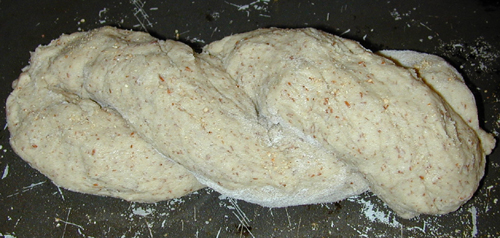
I wanted to put sesame seeds on the outside, but didn’t have any. So I did a light sprinkling of some ground sesame salt we had. I didn’t do anything in place of the egg wash for the outside.
I put this in the oven, turned it on to 150*F for a minute, then turned it off (it was a cool day), and let it rise for a little over an hour. Then we turned the oven on to 350*F and let it bake for one hour. The bottom got a bit over-brown, almost black, but was still edible, and the crust was strong and thick. The insides were soft and luscious. I didn’t do a good job sealing one of the ends. Also the two twists never really melded together and were like separate pieces of bread.
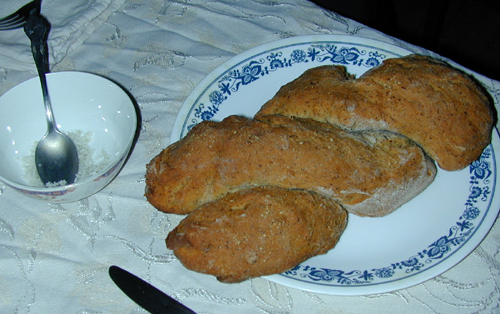
Our guests all loved the bread, though it didn’t really taste like challah and all of them were wheat-eaters. I’d gladly make it every week if it weren’t so carby. It’s definitely a winner for special occasions. I think dividing it into two loaves and baking it for less time would soften the crust while still cooking the insides.

10 responses so far ↓
1 Cornbread Challah (vegan & gluten-free) | Norwitz Notions // Oct 18, 2008 at 3:05 pm
[…] our last time hosting a Jewish potluck with these friends, we made a great challah from a Pamela’s bread mix. It came out great and worked well with a braid too. But Miriam had her first life-threatening […]
2 Laurel // Aug 4, 2010 at 11:20 am
Hi. I am mostly vegan (occasionally I find myself in a bind and eat “vegetarian” instead), and my brother-in-law has discovered that he needs to be dairy- and gluten-free. I have been looking for a way to surprise him with gluten-free, dairy-free (and for me EGG-free) challah.
The “Masa” one might not work, but this first one might. (He isn’t sensitive to tapioca.) Now to find that bread mix….
But you said it “really didn’t taste like challah.” Have you discovered any way to make it more “challah-y”?
Thanks for your postings. Any thoughts would be appreciated!
3 admin // Aug 4, 2010 at 11:31 am
Hi Laurel,
If you can eat eggs (or you’re willing to make it with eggs for your BIL), you’ll get a lot more of the challah texture. My daughter’s super allergic to eggs so I haven’t tried the mix that way, so I can’t tell you how much of a difference it will actually make. The Pamela’s mix makes really good bread. It’s just not *egg* bread. You’d want to up the eggs for the mix, not just use the basic amount, but I just don’t know how much or if you have to tweak it in other ways.
Challah of course is traditionally dairy-free. There must be some GF recipes out there. I was going to suggest you do a search except, duh, that’s how you found me. 🙂
If you have success, please post about it!
Cyndi
4 amy g. // Sep 14, 2011 at 5:23 am
hi cyndi-i didn’t realize that challah is traditionally dairy free. i could have sworn when we used to make it in the bakery there was butter in it. those were pre-allergy days…
5 Cyndi // Sep 14, 2011 at 9:27 am
Hi Amy,
Challah can be made in all sorts of ways. But it is traditionally used for Shabbat dinner (Friday night; or other holidays) and that dinner usually contains meat (for many families who couldn’t afford to eat meat regularly, they would try to have some for Shabbat). Kosher rules of course prohibit eating dairy and meat in the same meal.
If your bakery was selling challah to people who weren’t Jewish, or were but didn’t keep kosher, or who were vegetarian, or who wanted the challah for purposes other than having it at dinner, etc, then the butter wouldn’t be an issue (for those who otherwise ate dairy that is). Challah is delicious (makes great french toast too) so lots of people buy it for non-ritual purposes.
So, yeah, if you look at Jewish cookbooks, all the challah recipes will be nondairy. Unless there is a special “brunch” version or something. Or it’s a vegetarian Jewish cookbook. Gosh I have a lot of exceptions in this comment 🙂
Cyndi
6 DeenaJR // Mar 3, 2016 at 8:30 am
Thanks for sharing! Maybe if you put a bowl/pan of water in the oven while it’s preheating the moisture will help the crust too 🙂
7 Shannon // Apr 9, 2016 at 11:02 pm
Trying this recipe–thanks for posting it!
I’ve used ground golden flax for the egg,
coconut oil for the shortening, and an unsweetened vanilla rice milk, and coconut sugar. Also added raisins (2/3 cup) because….
Glad for all the tips you included! I didn’t add extra liquid, but I still used some rice flour so that I could partially “knead” (more like fold by hand) in some cinnamon and extra sugar, and also to help with (gently) forming the three sections.
I made some extra flax “egg”, used it to help join the ends (and even the braid) together, and brushed some on the the finished braid before letting it rest. After it rested about an hour in the oven, part of it had broken open; I used some left-over flax mixture and a little warm coconut oil to put the braid back together, and coat the (now larger) loaf.
Didn’t bake it for a full hour, as it was looking and smelling on the verge of too-done after about 55 minutes. Might try 325 degrees next time? Feels pretty heavy for bread, but smells good…..
8 Cyndi // Apr 10, 2016 at 7:30 am
Thanks for the feedback and the tips, Shannon and Deena!
9 Lois Pearlman // Sep 29, 2021 at 1:07 pm
You have to love a shul that offers a recipe for gluten free vegan challah. I think I will try it with real eggs and olive oil or butter, since I’m gluten intolerant but not a vegan.
10 Cyndi // Sep 29, 2021 at 1:55 pm
If you call “use this mix” a recipe LOL. But, sure, use whatever ingredients you want. Challah is traditionally parve (no dairy) but yes it usually has eggs. My daughter is no longer allergic to eggs so we can use them now, but I’m very dairy allergic and don’t do great with gluten. You can put some certified GF oats on the outside if you want to be able to say motzi over it.
Leave a Comment